Introduction
With the current LCMS presidential election, I think that it is time I write an article on why the LCMS should integrate an Episcopal Polity. The LCMS is a very catholic body within the United States. Like all church communions the LCMS has her issues but they do not outway the good that is in her borders. One of the issues that the LCMS struggles with is her unity and an agreed on definition of the pastoral office (This is a dividing wall between WELS & LCMS). There is a simple solution: a return to the Three-Fold office in the One-ness of the ministry of the Episcopate. There are many in the LCMS, especially the laity that would be advocates for this. I believe that this can be done without compromising the Lutheran traditions emphasis on the congregational function of the church.
//Note: This is not an in depth theological analysis, but rather my thoughts on episcopacy, Lutheranism, Anglicanism and the ecumenical dialogue from a broad view.
The patristic role of the Bishop is not an office of lord-ing, but it is an office of serving. The office of the gospel Bishop may help the LCMS itself because the office serves in three ways:
- Unity
- Oversight
- Worship
Unity
The Bishop acts as a symbol of the person of Jesus Christ in the Eucharistic community. Jesus prayed, “May they all be one, as you, Father, are in me and I am in you. May they also be one in us, so that the world may believe that you sent me” (John 17:21; Evangelical Heritage Version). Why does Jesus say that the church should be one? So that the world may believe that Jesus is the Messiah, the Son of the Living God. This will not happen unless the church is one. The Bishop was instituted by the Apostles (what I mean will be touched on later) in order that the church may have a visible unifier.
Oversight
Oversight, where we get the word Bishop. It is the main function of the Bishops office to oversee the church. This function of the Office is chiefly seen in being given to the Apostles in the Office of the Thrones. “Amen I tell you: In the renewal, when the Son of Man sits on his glorious throne, you who have followed me will also sit on twelve thrones, judging the twelve tribes of Israel” (Matt. 19:28). The throne (or cathedra) of the Bishop parallels that of Moses. The seat of Moses is that of the Scribes and the Rabbis would sit in that would represent the teaching of the Law. This has been superseded by the seat of Christ. The Bishops sit in this seat as a steward of the teachings of the Gospel. They explicate the Law and administer the Gospel from the authority given them by Christ. The Apostles being our chief Bishops are sitting on Twelve Thrones judging the Church. The Bishops under their authority judge the Church militant.
Worship
Worship may be the Bishops’ top priority. His chief aim is to be sure that the worship in his congregations is being done “according to their design, which is being shown to you on the mountain” (Exodus 25:40). This means that worship will be done as it has been shown in the visions of the prophets from Moses as being fulfilled in Christ and revealed in John’s apocalypse (This can be explained in later articles). This means the Bishop’s locus of authority and chief concern is to be sure that the people are being called, they confess their sins and are absolved, they hear the word of God read, they hear the Word of God preached, confess the faith, they pray for all people, the Bread and Wine are properly consecrated to be the Body and Blood of Christ, they receive Him, and are sent into the world. In other words, the Bishop maintains the Divine Service as revealed in scripture, passed through the ages, and adapted to local culture.
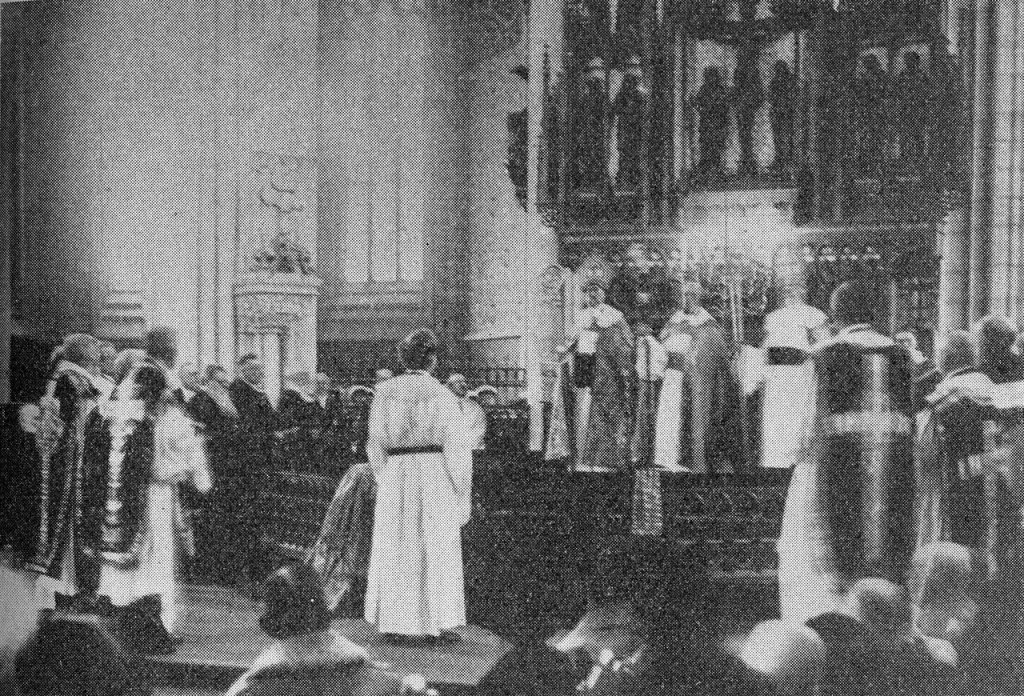
Nathan Söderblom is ordained as the Lutheran archbishop of the Church of Sweden, 1914.
The Benne, Plenne, and Esse of the Bishops office.
The Lutheran view of the Episcopate rejects that the office of Bishop is the essence (esse) of the church. I would agree with this. The essence of the Church is Jesus Christ Himself and where He decides to send the Spirit. The signs of the Spirit are found in the administration of Word and Sacrament. “In fact, there are three that testify: the Spirit, the water, and the blood, and these three are one” (1 John 5:7-8). I understand that this verse is in few early manuscripts but it testifies at the very least to an early view of the Spirit. He is found in the Water (Baptism) and the Blood (Holy Communion). Then the essence of the church is found in the preaching of the Word and the right administration of the sacraments. Many Lutheran theologians would argue that the office of the episcopate is for the good order (benne esse) of the church. This is made confessionally binding for Lutherans as a minimum view in the Book of Concord.
If the bishops would be true bishops [would rightly discharge their office], and would devote themselves to the Church and the Gospel, it might be granted to them for the sake of love and unity, but not from necessity, to ordain and confirm us and our preachers…
-Smalcald Articles, X.1
This means that Lutherans, if the option for having gospel Bishops in apostolic succession presents itself should consider the episcopate for the sake of unity and love between Christian brethren.
I would argue that this view leads to a fullness (plenne esse) view of the Episcopate. Jesus Christ himself was careful not to ordain any offices in the church. The only people that he gave authority to were the Apostles. Jesus did this because he knew that history would get messy and if the essence of the church relied on Bishops then the church could die which He promised would not happen. Rather Christ let the Apostles, led by the Spirit, institute the offices of the Church as they saw fit. Their authority is subordinate to Christ but over the Church (Eph 2:20). Their thrones being under His. Throughout the book of Acts and the life of St. Paul instituted the office of overseer, elder/pastor, and deacon to be for the proper functioning of the life of the Church when they were gone. They delegated the three functions of the Apostolic office (unity, oversight & worship) to the Bishops and then to Elders and Deacons. If this is true then the fulness of the life of the church is found in the Three-fold office as revealed by the apostles and confirmed by the earliest traditions of the Church. By consequence all churches should strive for these offices and the unity of the Church in the office of the Bishop.
See my articles Reformed Catholic Presbyterianism and Bishops in Presbyterianism for a more substantial argument from Scripture and Patristics for the Three-fold office of Bishop, Presbyter, and Deacon.
Implementation
First of all, the closest ecumenical partner to the LCMS is the Reformed Episcopal Church. Continued dialogue with the Reformed Episcopal Church should be held until a full communion agreement can be held.
I believe that four resolutions should be enacted by either side
REC Resolutions:
- The REC is in full agreement with the unaltered Augsburg Confession, and Luther’s Catechisms in such a way that does not deny Anglican heritage and catholic understanding but strengthens the REC’s understanding of Covenant and Law/Gospel distinction
- Christ’s presence in the Bread and Wine is substantial, not by virtue or power. His presence is in such a way that the Bread and Wine can be truly said to be the body and blood of Christ in a real but mysterious way.
- Altar and Pulpit fellowship with any ecclesial body and individuals should be entered into on the grounds of doctrinal agreement of the Gospel, Ministry, and the Catholic Faith.
- Clarify that God is not the author of evil and in no way does he want anyone to go to hell but rather he “wants all people to be saved and to come to the knowledge of the truth.” (1 Tim 2:4).
LCMS Resolutions
- An adoption of the Chicago-Lambeth Quadrilateral
- An adaption of the Historic Episcopate to the LCMS’ current ecclesial system
- An official recognition of Anglican/Lutheran joint heritage and catholic understanding
- An official statement on Evangelical Catholicity that promotes unity through Creeds and the Ecumenical Councils and an interpretation of the Book of Concord through the lens of the Patristic fathers.
These are tall pillars to reach. I believe through continued dialogue they can be reached. Lutherans and Anglicans conservatives for too long have been divided. The office of the Episcopate can help them to reach this unity.
Postscript
The LCMS needs Bishops to ensure the following:
Here is the official position of the LCMS on Worship and the use of the ordo (the order and constituent parts of the Divine Service), from a resolution from the 2016 LCMS national Convention. Don’t ditch the confession and absolution. Don’t ditch the creeds. There is no right to rob the people of the ancient creeds which we wholeheartedly confess. Don’t rob the people of the three readings of the lectionary. The Augsburg Confession says specifically we retain vestments and the lectionary. Don’t mess with the LORD’s Supper. There is great freedom to use various settings. Keep the ORDO. We are not evangelicals. We are Lutherans.
—President Matt Harrison; Facebook, December 10, 2025
LCMS always says they will keep the traditions of the Church but they struggle at a “Why?” Why should the Lutherans keep the Divine Service. The “why” is all things for catholic practice are contained in the Scriptures but are not necessarily explicit commands, rather we are commanded to follow patterns. The Mass is the pattern revealed on the mountain and passed down from the Apostles. Just because its not explicitly commanded in scripture does not mean that we can cast it aside as not binding. The mass is binding because it fits the pattern of scripture and has been passed through the Church as the pillar of truth by the Spirit. This does not mean that ceremonies need to be the same everywhere. Rather the pattern must match scripture.
Examples of the Mass as Culturally adapted on the different Continents. The Mass is commanded in scripture through pattern and thoroughly catholic.
All scripture quotations are from the Evangelical Heritage Version, a WELS-ELS Lutheran version of the Holy Scriptures


Leave a comment