History is a blessing and a curse. The 10,000 year known history of mankind is so vast that no single man could learn it all. This leads to many interpretations of history. What is an interpretation? It is a narrative that pieces together as much of the data as possible into a coherent story so that Man can understand himself. Every person has a narrative history of himself.
I grew up in Fresno, CA. I love Christ, the Church, and my family. I put value into truth, goodness, and beauty. The goal of my life is to love God and enjoy him forever.
This is an example of a coherent personal narrative or identity. Society as a whole has these too:
America was born on the concept of individual liberty, freedom, and justice for all
or
America was born on the backs of slaves and because of this Americans must repay those they have conquered.
Which of these histories is correct? Both narratives require extensive research on the part of the individual to understand the complex issue of “What is America?” This causes massive tensions throughout society. Since at least the 1960’s this very question has caused race riots in America. Further division is caused by not a lack of knowing history, but by interpreting history through a certain narrative lens. This very same concept, different interpretations of history causing division, lends problems for another important question, “How may I be saved?”
“How may I be saved?” This question has many nuances to it that I cannot get into here but I am going to dissect a main issue of today that flows out of this question: “Do I need to be a part of an institutional church to be saved and if so which one?” There are a few historical narrative ways that you can tackle this question.
- Christ did not institute a worldly institution; rather He meets all people directly through His word by His Spirit in order to give them a changed heart to be saved.
- Christ instituted a worldly institution, and entrance into this institution is the first step towards salvation. Outside this institution their is no salvation
- Christ instituted a worldly institution to be the primary means by which he meets people through His word and by His Spirit in order to give them a changed heart to be saved. Normatively, outside this institution there is no salvation
Narrative One – The Restorationist
These three narrative worldviews are how most Christians see salvation. Mind you, these are highly simplified caricatures of these narratives but they are narratives none the less. The first narrative is the story of Restorationist Christianity. In its many forms it prioritizes that God meets people directly through experiences that change the heart. None of the other systems deny this; they just emphasize that God must tie himself to means for our assurance. God normally does not reveal Himself audibly, visibly, or miraculously to anyone. Most Christians throughout history could expect to die having no miracles done in this life. This means that when a Christian says that his heart has been changed but there is no outward sign to confirm that this change is from God then the Christian only has his own inward testimony to bear witness to his conversion. Since that new Christian is still a sinner, when he fails, he falls into anxiety. Once this Anxious Christian realizes that he needs something outside himself and an object to hang his confidence on he meets the next two narrative world views.
Narrative Two – The Ecclesialist
Narrative two says that there is one institution in this world that the Christian can hang his hat on and this is the One, Holy, Catholic, and Apostolic Church. “Great, I will join this church!”, says the Anxious Christian. To which he gets four different answers, “Submit to the Pope!” “Come home to the Eastern Orthodox!” “The Oriental Orthodox are waiting for you!” “The Church of the East is your home brother!” These four answers require doctorate level study to come to a level of understanding to be able to distinguish which church is the real Church. Let’s just look at some categories that would have to study in depth to come to an understanding of the “One True Church”
- The Papacy
- Episcopacy
- Sacramentology
- Soteriology
- First 7 Councils
- 2nd Nicea Controversy
- Church Fathers: Apostolic, Ante-Nicene, Nicene, Post-Nicene
- The Great Schism
- The Papal Schism
- The Canon of Scripture
You could possibly come to a basic grasping of these concepts in a few months. Unfortunately every ecclesialist church has a different view of each one of these 10 concepts. To truly understand the nuances of even just one of these concepts and to be sure that you are correct could take more than one lifetime. Does God really damn someone who genuinely believes in Jesus Christ but struggles to understand these complex issues. Anybody who can tell you that he has the answer to the Papacy problem is either lying or hasn’t read enough on the papacy to be able to understand the gravity of the claim that the papacy is the vicar of Christ, the universal Bishop, and infallible. This doesn’t even get into the other nine issues of the ecclesial churches. This then leads the Anxious Christian back to narrative one. There is a third way. The Ministerial Narrative
Narrative Three – The Ministerial Church
Jesus Christ came to save sinners. The church must hold in tension that the scriptures say two things at the same time. The church is both necessary for salvation and Christ meets individuals where they are to bring them to salvation. “For God so loved the world, that he gave his only begotten Son, that whosoever believeth in him should not perish, but have everlasting life” (John 3:16 KJV). This is the gospel call to all sinners. It is true that anyone who hears the gospel and repents will be saved. It is also true that Christ instituted a church. “…which is the church of the living God, the pillar and ground of the truth” (1 Timothy 3:15). The church then is defined by both its ontology and its function. The church is the bride of Christ and it is also the proclaimer of truth to the world. The Church is the way by which the Gospel reaches sinners. The Church is defined not by her priests but by all those who have put their faith in Christ and have been Baptized in His name. There are then two ends of the Church on earth. A bottom half and a top half. The bottom half is the priesthood of all believers. Those baptized and sent into the world to be a light in the darkness around them. Then there is the top half, the Bishops and Presbyters entrusted with guarding the faith and feeding God’s people the Word and Sacraments. Then a true church is any church which has both. The Augsburg Confession outlines this simply,
“The Church is the congregation of saints, in which the Gospel is rightly taught and the Sacraments are rightly administered.” – Augsburg VII.1
This simple view of the church allows for all anxieties to fall. That as long as rightly called ministers of the gospel are preaching the Word, Baptizing the faithful, and offering the Mass then there one can find the Church. One can affirm that Rome, the East, Anglicans, Lutherans, and Reformed are all part of the one true church although divisions there may be. Christ would not have to pray that the Church be one if He thought the Church would never be divided. Division can be a good thing for the clarification of doctrine and the admonishment of sinful people. This does not de-church any church body that has presbyters, preaches the gospel and administers the sacraments. It also allows for the Anxious Christian on the bottom end to say, “that when my sins and conscience oppress me, I strengthen myself and take comfort and say: Nevertheless I am baptized; but if I am baptized, it is promised me that I shall be saved and have eternal life, both in soul and body” (Luther, Large Catechism, Of Baptism; 44). This means that even if one is baptized in a Restorationist body, as long as it was done in the Triune name that Baptism was effectual to salvation, and that by God’s providence, by trusting in Him He will lead the Anxious Christian to the Truth found in His church.
The question then of which church do I join then becomes not a question of salvific anxiety, rather it becomes a question of which real Church presents the gospel in the best light. As a protestant I would argue those of the Magisterial reformation present both the Law and the Gospel in the clearest sense and have the purest sacraments. Then one must join these churches. In this I cannot choose wrongly because I am asking God to lead me to the true Church based in real faith. It is not because I hate my Roman or Eastern brothers but it is because God has not led me into these true churches. He has led me to the one I am in as of now because He knows this is where I need to be. This does not give license that any group is a true church. Rather it is to trust God that if one is genuine in faith and is seeking truth and repentance and not feelings above all else, God will guide the Anxious Christian to true church bodies.
If a son shall ask bread of any of you that is a father, will he give him a stone? or if he ask a fish, will he for a fish give him a serpent? Or if he shall ask an egg, will he offer him a scorpion? If ye then, being evil, know how to give good gifts unto your children: how much more shall your heavenly Father give the Holy Spirit to them that ask him? – Luke 11:11-13
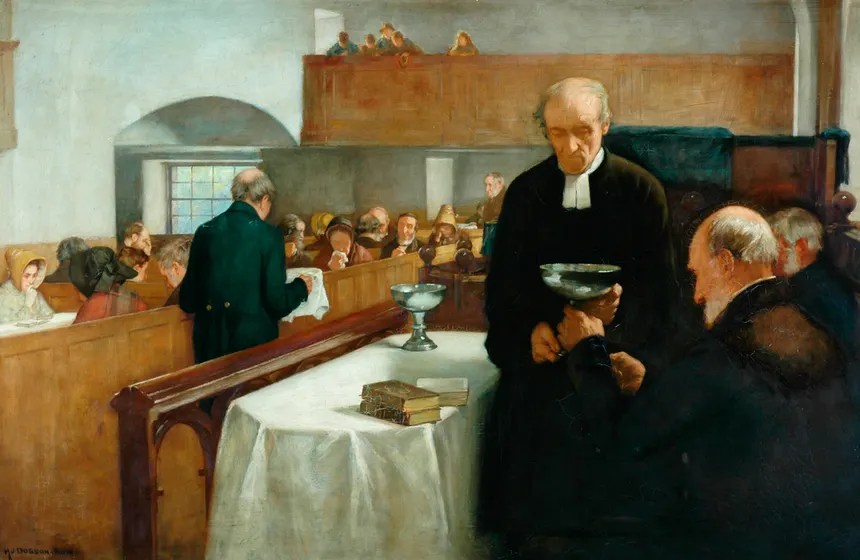
A Restorationist body are those groups that say that there is no visible institutional church, that the church died during some period of time and that the true Gospel had to be restored. These churches cannot be true churches since normally they were started at random by some person without connection to the wider church through presbyters or bishops. They do not preach the creeds and they do not normally administer the body and blood of Christ. This does not mean that most people who are members of these bodies are not Christians. If they are baptized in the Triune name then they are part of this invisible catholic church. God wants them to come into true churches to receive the comfort and support of his Word read and preached and sacraments administered. True churches should make it a mission to evangelize to these wandering brothers.

Leave a comment