Introduction
“God is to be worshipped everywhere in spirit and in truth; as in private families daily, and in secret each one by himself. … The head of the family is to take care that none of the family withdraw himself from any part of family-worship.” – Westminster Assembly — Directory for Family Worship (1647)
Every Christian must have a rule of life to guide his prayers and devotions to the Lord. A rule of life is a set daily, weekly, monthly, and yearly pattern of ordering worship, devotion, fasts, feasts, alms, and service.
What is a rule of life?
A rule of life is a discipline by which I order my worship, work, and leisure as a pleasing sacrifice to God.
Why do you need a rule of life?
I need a rule of life because my fallen nature is disordered, distracted, and self-centered. A rule of life helps me to resist sin and establish godly habits, through which the Holy Spirit will increasingly conform me to the image of Christ. – To be a Christian Q. 252 & 253
In order to order this devotion rightly and to encourage regular prayers every home should have a dedicated space for prayers and devotions. In the Christian faith this is most commonly been expressed through the home altar. This is because every Christian home is its own temple for the glory of God. This is because Christians reside and sanctify these places. Christians offer up sacrifices of praise and thanksgiving singing “psalms, hymns, and spiritual songs” (Eph. 5:19).
“Every family should be a society of religion, and every house a church, and every householder a priest. … Let every morning and evening the family meet together, and the prayers which are publick in the church be read privately in the family.” – Jeremy Taylor Holy Living (1650), ch. I, sec. 4
To set up this home altar a 4 basic categories can help
- Bible & Prayers
- A Table
- Devotional Aids
- A Kneeler
Bible & Prayers
Bible
Every home altar Bible should have the full canon and Deuterocanon of Scripture to be the primary Bible the individual and family reads together.
“We do not deny that certain books of the Old Testament were by the ancients called Apocryphal, and by others Ecclesiastical; to wit, such as they would have to be read in the churches, but not alleged to avouch or confirm the authority of faith by them.” –Second Helvetic Confession (1566), ch. 1
It is important that morning and evening families and individuals come together to read the full breadth of scripture every year at home along with their Sunday obligations. In my opinion the best full translations of scripture in the English Language are the King James Version, English Standard Version, Revised Standard Version (RSV-CE). Following a common lectionary with your family and friends is a good way to keep accountable and make sure to be inwardly digesting the scriptures regularly
Blessed Lord, who caused all holy Scriptures to be written for our learning: Grant us so to hear them, read, mark, learn, and inwardly digest them, that we may embrace and ever hold fast the blessed hope of everlasting life, which you have given us in our Savior Jesus Christ; who lives and reigns with you and the Holy Spirit, one God, for ever and ever. Amen. -Advent 2 Collect BCP 1549
Prayers
Along with a Bible, every Christian should have a rule of prayers given from his tradition. This rule of prayers should not be self assigned but rather from his or her given tradition because we can be too light upon ourselves. All Christians should strive to at least pray the morning and evening prayers. A great place to start is Martin Luther’s Morning & Evening prayers from his small catechism. I will go through each traditions prayer rules now:
Lutheran
As said before, Luther’s small catechism prayers are a great place to start for any Christian with morning and evening prayers. The most basic daily office consists of the sign of the cross, the Creed, and the Lord’s prayer. This is the core of any prayer life. If you are part of WELS then the new hymnal Christian Worship is your primary source of liturgical life. If you are LCMS then the Lutheran Service Book is your prayerbook. Both of these resources contain the Daily Office (Morning & Evening Prayer), a lectionary, the Divine Service, and Hymns.
Anglican
For Anglican Christians the Book of Common Prayer (BCP) is the liturgical prayer life. For the ACNA the 2019 BCP is the main prayerbook for you. I would recommend this prayerbook for any Christian who has not ever prayed the daily office. It’s services are simple and easy to follow. Also its family prayer sections and inclusion of Compline (before bed prayers) are excellent. If you are a part of the Reformed Episcopal Church or a Continuing body I would encourage the use of either the 1662 BCP or the 1928 BCP. The Reformed Episcopal Church also has its own BCP but these can be hard to come by. All of these contain the Daily Office, a lectionary, and the Divine Service. For a fuller experience a breviary such as the St. Bernard Breviary , the St. Aelfric’s Breviary, or The Anglican Office Book can give a fuller and more rich Daily Office experience and include hymns. These are for the more experienced in the Daily Office.
Reformed
The more puritan in mind reformed emphasize free flowing prayers yet they never rejected the set prayers of the church. The Westminster Directory for Family Worship sets up guidelines for this private home worship. For a more specific family and individual prayer book the book Be Thou My Vision is a great daily office prayerbook for Reformed Christians. This prayerbook contains the Westminster Shorter Catechism and the Heidelberg Catechism, along with a lectionary, and 31 unique morning and evening offices. The Valley of Vision is a great devotional aid to this book as well. The 1662 Book of Common Prayer is also a great prayerbook that fits within the Reformed camp.
Table
The table should be a plain wooden table. It can really be anyplace on which you will sanctify. This means you will set this place and table apart in your home for the specific purpose of prayer to God. You will not set your phone or other objects on this table. It will be an altar to the Lord your God and an Altar alone. This is to keep a reverence about holy things and this Altar will be a constant reminder of God’s presence in the home. Is the Altar in and of itself holy? No, of course not! Rather its purpose is holy and it is only holy in as much as it is used for holy things, the piety of the family or person using it, and above all it is holy because of the God that is worshiped there.
“Keep up the worship of God in your families; call your household together daily; read some part of the Word; sing Psalms; pray together; and let the same order of God be kept in your family as in the Church.”
– Richard Baxter Works IV:234
Devotional Aids
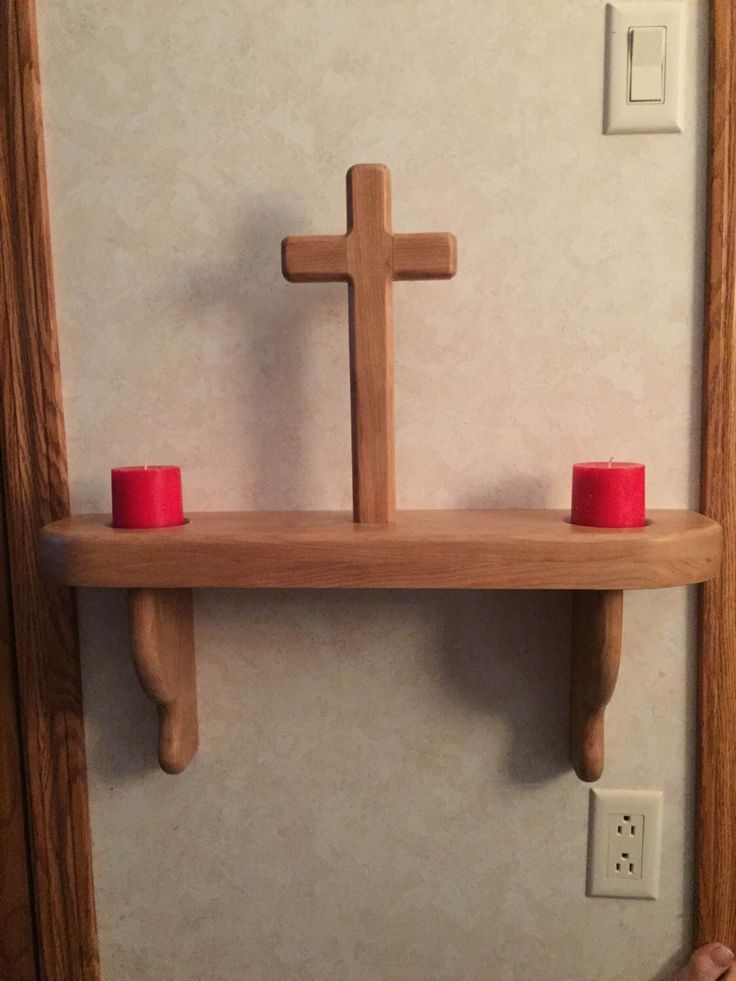
There are a few devotional aids to be had on this Altar. The most basic devotional aids are a linen cloth, a cross, and votive candles.
A simple altar like the one seen here can help to remind oneself that Christ is the light of the world and that it is the cross that led to our redemption. It is important that all Christians do not turn their devotional aids into idols. Like the bronze serpent in the book of Numbers good and salvific devotional aids can become idols quickly. We must only use devotional aids to point to Christ not replace Christ.
The Second Council of Nicaea safeguards us against this kind of idolatry
Certainly this is not the full adoration {latria} in accordance with our faith, which is properly paid only to the divine nature, but it resembles that given to the figure of the honoured and life-giving cross, and also to the holy books of the gospels and to other sacred cult objects. Further, people are drawn to honour these images with the offering of incense and lights, as was piously established by ancient custom. Indeed, the honour paid to an image traverses it, reaching the model, and he who venerates the image, venerates the person represented in that image. –Extract from the Definition of Nicaea II
Images such as crosses are only to be used to point use to Jesus Christ and not replace Him.
Other devotional aids can include other images such as that of Christ and the Saints. These serve to remind us of Christ and the works of Him and His saints. The reformed camp may be uncomfortable with this. The Dutch and German Reformed tradition has a beautiful tradition of simple iconography.
Images such as the one seen here is an example of Reformed Iconography that may be acceptable to their consciences as a devotional aid.

Another important devotional aid and offering is incense.
For from the rising of the sun to its setting my name will be[a] great among the nations, and in every place incense will be offered to my name, and a pure offering. For my name will be great among the nations, says the Lord of hosts. -Malachi 1:11 ESV
Malachi here is prophesying that the Church will offer incense morning and evening as a sacrifice of praise to God for what the Son has done. A great place to find incense and an incense burner along with Icons is Legacy Icons (Eastern Orthodox). I recommend the smokeless incense burner pack for those starting with offering incense.
The last devotional aid I will recommend is other books. The Apostolic Fathers are a great starting place for reading the saints and gaining theological perspective. Reading the Lives of the Saints is also a great way to get in contact with Christian Saints over the past two millennia. I personally read this one. Also reading your own traditions’ confessions of faith and catechisms is a great devotional aid. The Reformed Press resources page has links to these things.
Kneeler
Finally I recommend a kneeler. This is because we are commanded to kneel in worship and penitence to our God.
“Oh come, let us worship and bow down; let us kneel before the Lord, our Maker!” –Psalm 95:6
This is not a metaphor. We are commanded as Christians to physically kneel before the Lord. Our physical posture reflects our heart posture and we must align the two for proper worship. I recommend a kneeler (or a simple pillow) because kneeling for the Daily Office can hurt after a while.
Conclusion
A home altar is vital for the life of the Christian. We must center our lives around prayer. If a space in the home is not set up for this it can be a lot easier to back slide into not praying regularly. The Daily Office, a rule of life, and a home altar fights this tendency. All Christians must have a home altar to guide their prayers and life to the Lord.
“So Abram moved his tent and came and settled by the oaks of Mamre, which are at Hebron, and there he built an altar to the Lord.” -Gen 13:8

Leave a comment