Psalm 137 has been popularized from the game Fallout New Vegas when the Mormon Joshua Graham quotes it. This inspired me to write an expository paper on the psalm for my Psalms class with Dr. Daniel Carver at Lancaster Bible College.
The previous expository paper studied Psalm 137 from an event level perspective. In Psalm 137 the Israelites have been conquered by the Babylonians and taken into exile. Psalm 137 is trying to convert that though Israel is in captivity, they will trust that if they remember Zion, the Lord will bring justice upon the Edomites and Babylon. “Loyalty lies in remembering (v.1) instead of forgetting (v.5). The godly could not forget Jerusalem and everything it stood for— covenant, temple, the presence and kingship of God, atonement, forgiveness, and reconciliation” (Longman, 1067). The psalmist is writing in order to show the loyalty of the people of Israel to the covenant will result in the redemption of God’s people because God will keep his promises.
There is no other place in the scriptures where Psalm 137 is directly quoted, although there are heavy allusions. Psalm 137:1 is very similar to Lamentations 1:3-7, where Jeremiah is lamenting over the fall into exile and the sorrow of the destruction of Jesusalem is described. In Psalm 137:4, the Psalmist weeps over the fact that they cannot sing the Lord’s song without Jerusalem, implying without the Temple. In Ezekiel 11:16 God reassures His people that he will “ …be to them as a little sanctuary in the countries where they shall come.” Showing that God will be present in a way to them, even though the fullness of his presence (His tabernacling with his people in the Temple) is gone. This will allow them to be able to sing the Lord’s song. There are also references to the imprecations. In Isaiah 13:19-22, the prophet proclaims that Babylon will eventually fall. In Jeremiah 51:24-26, the prophet proclaims God’s judgment over Babylon for its actions against Israel. Further, in Obadiah 1:10-14, the prophet proclaims a very similar judgment upon Edom. Finally, in Revelation 18, Babylon is proclaimed as destroyed. God in these verses answers his people’s cries for justice in Psalm 137. The New Testament also makes allusions that the New Israel, the Church, is sojourning in the same way as in Psalm 137. In 1 Peter 2:11, the apostle writes, “Dearly beloved, I beseech you as strangers and pilgrims, abstain from fleshly lusts, which war against the soul;” The members of the Church are in a state of journeying to the true Zion which is the new Jerusalem. St Peter is referring to the exilic tradition that the Christian is not in his true home until the New Jerusalem descends to the earth. Until then, the command from the Lord to “Build ye houses, and dwell in them; and plant gardens, and eat the fruit of them“ (Jeremiah 29:4-7). This is what the Psalmist is lamenting over in Psalm 137:5 when he says, “If I forget thee, O Jerusalem, let my right hand forget her cunning.” Though the Christian and the Jew both be pilgrims in a foreign land God had called them to settle in those lands but not forget that Jerusalem is the true home. This is further reflected in Philippians 3:20 which says, “For our conversation is in heaven; from whence also we look for the Saviour, the Lord Jesus Christ.” The longing of the Jew of the exilic period and the Christian is shown to be the same: the return of Zion.
The difficult part of this Psalm, that is always used to show the unfairness and the evilness of the God Yahweh, is verses 8-9, “O daughter of Babylon, who art to be destroyed; happy shall he be, that rewardeth thee as thou hast served us. Happy shall he be, that taketh and dasheth thy little ones against the stones.” How could it be considered good for the people of God to call for the slaughtering of Infants? The church father, Theodoret of Cyrus, sees this not as an actual imprecation, but a prophecy of what will come. He says,
What is the meaning of this? Blessed is the one who will take up and dash your infants against the rock (v. 9). In other words, since they for their part treated their infants cruelly, the inspired author prophesied the like punishment for them. Consequently Cyrus is declared blessed for punishing them and freeing these [Le., the Jews],3 not because he was reared on sincere piety but because he accorded the pious people liberty and gave directions for the building of the divine Temple. God receives few fruits and provides generous rewards-hence his hailing the widow’s two coins. (Theodoret, 324-325)
Theodoret identifies the one to reward the Babylonians for what they had done as not being Jesus Christ, as what a New Testament spiritual reading of the text would be, but he identifies the one who would reward them as being King Cyrus of Persia who would destroy the Babylonian empire and return Israel to their land and institute the rebuilding of the Temple in Jerusalem. This answer curbs the common rebuttal against this imprecatory psalm in not calling it imprecatory at all but rather a prophecy of the destruction of Babylon.
John Calvin has a very similar interpretation. He says, “The Psalmist discerns the coming judgment of God, though not yet apparent, by the eye of faith, as the Apostle well calls faith ‘the beholding of things not seen’ (Heb 11:1)” (Calvin, 196-197). This shows that Calvin did not view Psalm 137 as a call upon God to bring justice against the Babylonians and Edomites, but is a recognition and prophecy that God will bring somebody to destroy the Babylonians for what they have done. Calvin continues saying, “In declaring those to be happy who should pay back vengeance upon the Babylonians, he does not mean that the service done by the Medes and Persions, in itself, met with approbation of God; for they were actuated in the war by ambition, insatiable covetousness…but he declared that a war which was carried on in a manner under God’s auspices, should be crowned with success.” Calvin here sees that on an event level, the Psalmist is merely showing that God will successfully bring destruction on Babylon through means of a war. According to Calvin, the Psalmist is not calling upon the Lord for the reason of wanting justice, rather he is prophesying a coming event, unbeknownst to him.
This Psalm may have a few theological meanings for the Church today. The first is that even when the institution of the Church is scattered abroad, and the institution is not one, God is preserving his people among the pagan nations. “ But Jerusalem which is above is free, which is the mother of us all” (Galatians 4:26). The Babylonian captivity of the Church has continued from the Reformation until today and we must be prayerfully remembering that our true home is the Jerusalem above. This is why Christians must continue the prayer of the psalmist, “ If I do not remember thee, let my tongue cleave to the roof of my mouth; if I prefer not Jerusalem above my chief joy” (Psalm 137:6). In Psalm 137:2, the Israelites give up their harps because since they are not in Zion they can no longer sing the Lord’s song. The hope that God gives is that he will give us new harps at the coming of the true Jerusalem. “But when God has put down all arrogant earthly powers, God himself, who dwells in ‘Zion’ gives ‘harps’ to those of us who are ‘victorious’ that we may sing…” to him (Thompson, 405). This Psalm is answered by God in a message of hope as well as justice.
Another meaning for the Church today is that God will work out all things for the Glory of himself and his people. “O daughter of Babylon, who art to be destroyed; happy shall he be, that rewardeth thee as thou hast served us. Happy shall he be, that taketh and dasheth thy little ones against the stones” (Psalm 137:8-9). Through a spiritual reading of the text, Christians understand that the true King, Jesus Christ, is the one who shall be happy to bring justice against wickedness in the world. Christians can rest assured that although we are currently not living in the true Jerusalem, and wickedness is abounding, this is only for a time. Christ will return to lay vengeance upon the wicked.
If any man worship the beast and his image, and receive his mark in his forehead, or in his hand, The same shall drink of the wine of the wrath of God, which is poured out without mixture into the cup of his indignation; and he shall be tormented with fire and brimstone in the presence of the holy angels, and in the presence of the Lamb. (Rev. 14:9-10)
Those who do not follow Christ in this world, but follow the fallen angels in rebellion against God, will be tormented with fire and brimstone in the presence of Christ. This is the ultimate end of the wicked.
The Roman Church, which has the Pope which has seated himself as the vicar of Christ, and given himself universal jurisdiction over the whole church has lauded himself over his brethren Bishops, has done massive damage to the Church. The Roman church by tradition has always had a place of primacy among the Bishops, but in claiming universal jurisdiction over the whole church, deposing bishops wherever he will, and claiming authority over sees such as Constantinople, Antioch, Jerusalem, Canterbury, and the like, has overstepped his authority. CH Spurgeon, in talking about Rome’s corruption, says that Psalm 137:9 is a prophetic warning against this kind of power in the Church. He says, “When Papal Rome shall have filled up the measure of her iniquity, then “a mighty angel will take up a stone, like a great millstone and will cast it into the sea…” (Spurgeon, 240). This millstone, Spurgeon, equates with the stone referenced in Psalm 137:9.
The Church should see Psalm 139 as a prayer of hope in God’s justice and character. “These statements… offend those who prize the children of the wicked over the God against whom the wicked have rebelled” (Hamilton, 449). When reading the imprecatory psalms, Christians must remember two things. The first being that we are the ones who have offended God, who is all goodness, with our wickedness, and we dont deserve to live. Second is that death is not the end of life. When God takes a life, that is not the end of that soul. God gives all ample opportunity to repent of their sins.
For the wrath of God is revealed from heaven against all ungodliness and unrighteousness of men, who hold the truth in unrighteousness;Because that which may be known of God is manifest in them; for God hath shewed it unto them. For the invisible things of him from the creation of the world are clearly seen, being understood by the things that are made, even his eternal power and Godhead; so that they are without excuse: Because that, when they knew God, they glorified him not as God, neither were thankful; but became vain in their imaginations, and their foolish heart was darkened. (Romans 1:18-21)
The wicked know what they have done is wrong but they suppress it. As a consequence they deserve what is coming to them as declared in Psalm 137.
The end of the Athanasian creed can show the church two main things in relation to Psalm 137. The creed says,
He will come again to judge the living and the dead. At his coming all people shall rise bodily to give an account of their own deeds. Those who have done good will enter eternal life, those who have done evil will enter eternal fire. This is the catholic faith.One cannot be saved without believing this firmly and faithfully. (The Athanasian Creed)
The first thing this shows is that Psalm 137:9 is not lying. Jesus Christ will come to judge the wicked and bring them to account for what they did against Zion, both ancient Israel and the New Covenant Church. The second is that even though we are scattered abroad and there are divisions in the Church militant, the Lord is preserving a remnant in the catholic faith. The faith, “which was once delivered unto the saints” (Jude 3). The Lord will help us to not forget Zion, our heavenly home, which is what the catholic faith contends for.
Psalm 137 has much to say regarding Christians today and how they relate with the world. The Psalmist is exiled into a harsh world without the center of the Hebrew religion, the Temple, to take refuge in. The Psalmist prays that he will not forget Zion above all things. This is how the Christian should behave. Though we live in a broken world, where the Church is scattered, and it seems that the demons are winning, we will remember Zion, and happy shall he be that taketh and dasheth the Devil’s children against the stones. We will also remember that the Lord is coming with Zion to Earth and that we are to abide patiently and quietly in Him until he returns.
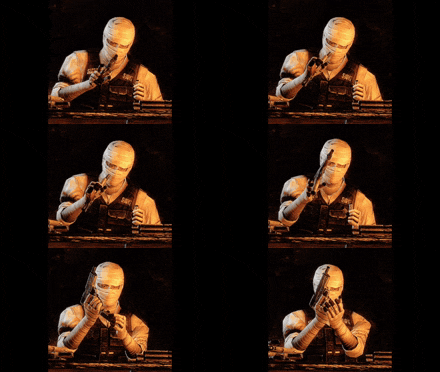
Joshua Graham from Fallout New Vegas
Works Cited
“The Athanasian Creed.” Reformed Church in America, 29 Jan. 2024, http://www.rca.org/about/theology/creeds-and-confessions/the-athanasian-creed/.
Calvin, John. Calvin’s Commentaries. Translated by James Anderson, VI, Baker Book House, 1979.
Hamilton, James M. Psalms. Vol 2, Lexham Academic, 2021.
Longman, Tremper, and David E. Garland, editors. Psalms. Revised ed., V, Zondervan, 2008.
Spurgeon, Charles H. The Treasury of David. Vol. 3, Zondervan Publishing House, 1977.
Theodoret, of Cyrus, Theodoret of. Theodoret of Cyrus : Commentary on the Psalms, 73-150, Catholic University of America Press, 2001. ProQuest Ebook Central, http://ebookcentral.proquest.com/lib/lbc/detail.action?docID=3134913.
Thompson, David L., et al. Psalms 73-150 A Commentary in the Wesleyan Tradition. Beacon Hill Press, 2020.

Leave a comment